
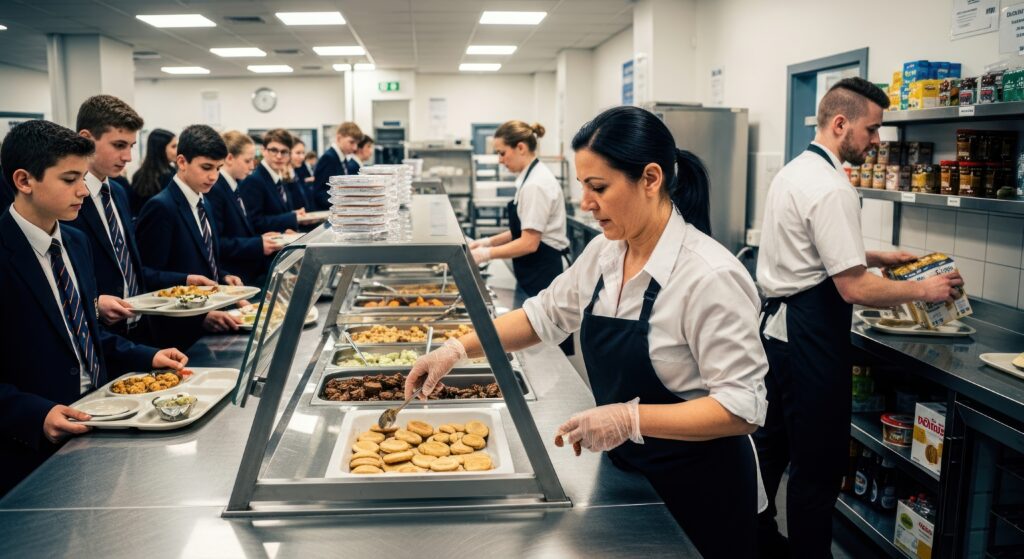
Running an in-house catering operation in a school can be challenging. The gap between government funding for Free School Meals and the true cost of providing a compliant, nutritious meal continues to widen, there are rising food prices, energy costs and recruitment challenges, along with increasing labour costs with further rises to the National Minimum Wage – including the National Living Wage – coming into effect in April 2026.
However, delivering the catering in-house gives schools and Multi-Academy Trusts (MATs) full control over their food provision – from menus and pricing to recruitment, culture, and community engagement.
Some schools choose to outsourced their catering as they welcome the specialist experience and don’t want to manage the day-to-day logistics, however for those that choose to run their operation in-house, done well, an in-house model can be more cost-effective than using an external contractor, avoiding management fees and profit margins, while allowing the catering team to feel part of the wider school community.
So, the question is: how can schools operating in-house, deliver safe, appealing and sustainable meals within tightening budgets?
The realities of delivering school food in-house
In-house catering teams must balance a complex web of financial, operational and regulatory pressures every day. Some of the most significant challenges include:
- Driving meal uptake and participation: Low meal numbers can quickly undermine financial sustainability. When fewer pupils take meals, fixed kitchen and staffing costs remain the same – meaning the cost per meal rises. Encouraging consistent uptake requires menus that are both appealing and aligned to pupil preferences, while still meeting nutritional standards and cost targets.
- Keeping pace with compliance and regulation: The world of school food is constantly evolving. From allergen legislation and Natasha’s Law to ever-changing nutritional guidance and food policies, maintaining compliance is non-negotiable. But it is time-consuming. For many schools, this adds an administrative burden that competes with the day-to-day demands of running a kitchen.
- Procuring the right suppliers: Schools are increasingly expected to source food that is not only affordable but also meets standards around quality, sustainability and ethical sourcing. Balancing cost with environmental responsibility – while managing multiple suppliers – can become a major logistical challenge.
- The administrative burden: From managing rotas and orders to tracking stock, invoices and compliance paperwork, in-house catering administration can be overwhelming. Manual processes increase the risk of human error, reduce visibility over spending and take valuable time away from food quality and service delivery.
Using technology to take back control
Schools delivering catering in-house should not have to manage this complexity alone. Investing in a robust catering management system can transform both financial performance and operational efficiency.
Litmus Edge has been developed specifically for the education sector to support schools. It brings ordering, stock management, supplier management, compliance reporting and financial oversight into one intuitive platform – reducing complexity and increasing control.
Schools using Litmus Edge typically achieve:
- Up to 20% reduction in overall catering costs, unlocking essential funds to increase spend on the plate
- Up to 15 hours per month saved on kitchen administration through automation and streamlined workflows
- Access to a network of specialist suppliers as well as the option for schools to manage their own existing supplier arrangement within the platform
- Single-point ordering and consolidated invoicing, removing the need for multiple systems and paperwork
- Easy menu planning through access to thousands of recipes with supplier-linked nutritional and allergen information
- Streamlined stock management and EHO compliance processes
- Real-time reporting dashboards offering end-to-end visibility
- Simplified team, task and diary management, allowing staff to focus more on meals and less on admin
At Litmus, we understand that catering is not just about food – it’s about systems, people and funding. Litmus Edge enables schools to reduce procurement costs and administration time, freeing up invaluable resources for what really matters: providing nutritious, high-quality meals for pupils.
A sustainable future for in-house catering
By investing in technology, understanding where money is being lost, and streamlining day-to-day operations, in-house catering can move from being a financial burden to a well-managed, efficient service that delivers both value and impact.
If you would like to find out how Litmus Edge could support your school’s in-house catering operation, please get in touch with our team here.
The Litmus team