

For many workplace catering teams, lunchtime competition doesn’t just come from rival caterers or emerging food trends – it comes food brought from home, and to a greater extent, the local supermarket.
The supermarket meal-deal has become one of the most influential forces shaping lunchtime behaviour in the UK. Convenient, familiar and often cheaper than workplace alternatives, it has established a benchmark that many workplace dining operations struggle to match.
But focusing solely on price misses the bigger issue.
The real challenge isn’t competing with supermarkets. It’s understanding why employees choose them in the first place.
The supermarket meal deal effect
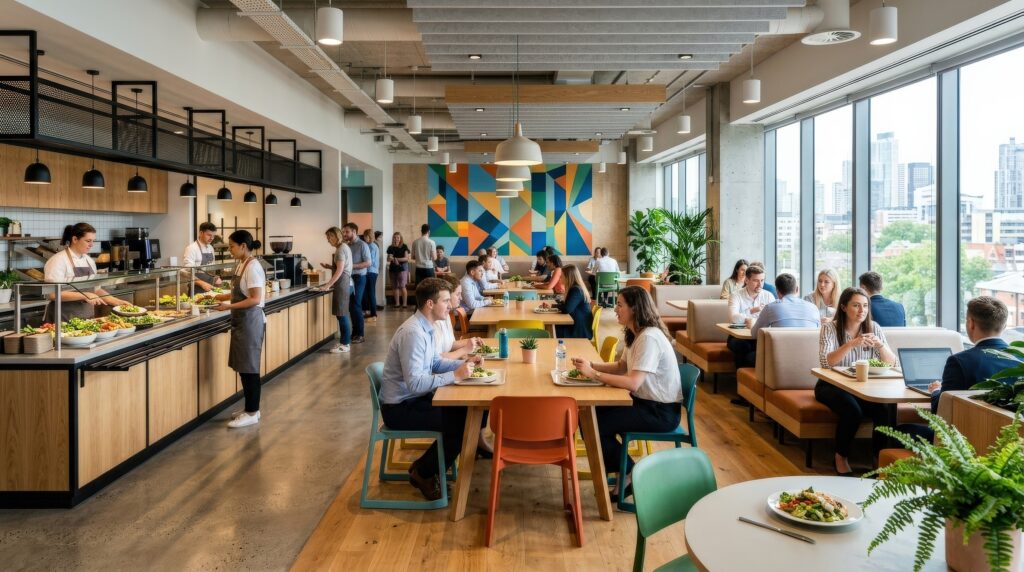
Most workplace dining environments offer more than a supermarket can. Hot food counters, made-to-order delis, salad bars and grab-and-go options provide variety and choice, but the real advantage lies in the freshness, quality, locally-sourced produce and overall dining experience they can deliver.
Yet many employees still leave the building at lunchtime. Perhaps that’s because lunchtime decisions are rarely driven by food quality alone. For many workers, lunch is a functional purchase made during a busy day. Employees are balancing rising living costs and, in that context, a workplace lunch priced at £7 (or more) can feel difficult to justify when a supermarket meal deal is available just minutes away for considerably less.
The question isn’t whether the workplace offer is better. It’s whether employees believe it’s worth the difference.
Understanding what employees value
Despite the workplace foodservice usually being well received, over time a gap can emerge between what operators think employees want and what employees actually value.
Employees see the same offers on the deli week after week – cheese, ham, prawn mayo and all the traditional fillings. While these staples have a place, they’re also readily available from supermarkets and high street retailers. If workplace dining is to encourage employees to stay on site, it needs to offer something they can’t easily get elsewhere. Once the offer becomes predictable and menu fatigue sets in, consumers start looking for greater variety and new flavours. The result is declining participation and reduced spend.
It’s key that workplace caterers understand that great food means different things to different people. For some employees, lunch is about speed, convenience and value. For others, access to a nutritious hot meal may be an important part of their wellbeing, particularly if they have limited facilities at home or long commutes.
The key question isn’t, ‘how do we compete with the supermarket meal deal?’ It’s, ‘does our food offer reflect the needs and priorities of our workforce?’
Want to understand what your employees really value?
Supermarkets operate at a scale that contract caterers simply can’t match, so replicating the supermarket model shouldn’t be the focus. Instead, the organisations that succeed are those that continuously listen to their consumers and adapt their offer accordingly. Workplace dining’s strengths lie elsewhere: freshly prepared food, menus that can respond to local tastes and seasonal ingredients, produce sourced from local suppliers, and dishes made on site by people employees know and trust. Combined with the environment, social interaction and tailored experiences that workplace dining can provide, these are the factors that create a compelling alternative to the supermarket meal deal.
Through research, benchmarking and consumer insight, we help organisations uncover the insights behind employee behaviours, expectations and dining choices, and create food offers that drive participation, support wellbeing and deliver measurable value.
If you’d like to find out how we can help your workplace dining offer stay relevant in a changing market click here.
The Litmus team